
Nothing ruins a road trip faster than coming back to a campsite and wondering if someone tampered with your rig while you were off hiking. That nagging worry is exactly why more full time travelers and weekend campers are finally treating a good rv security camera as essential gear, not an afterthought bolted on after something goes wrong.
The tricky part is that most cameras on the market were built for a house with a fixed address, a steady Wi-Fi router and an outlet in every room. An RV has none of that reliably. So the search for the right setup usually starts with a lot of puzzle options and ends with a much shorter, smarter list once you know what actually matters.
Why Standard Home Cameras Fall Short on the Road
A camera designed for a stationary house assumes constant power and a dependable internet connection. Your RV offers neither of those things once you’re parked at a trailhead or a campground with spotty signal.
Vibration from driving, temperature swings and long stretches without shore power all stress equipment that was never tested for that environment. That’s the gap that purpose built rv security cameras are designed to close.
What to Look for Before You Buy
Not every feature matters equally once you’re living or traveling part-time in a vehicle instead of a house. A few priorities rise to the top.
The Non-Negotiables for Mobile Setups
- No-drill mounting – Adhesive or magnetic mounts protect your RV’s exterior skin from permanent holes.
- Cellular connectivity – Campgrounds and remote trailheads rarely offer reliable Wi-Fi, so a system with its own data connection keeps working anywhere.
- Battery or solar power – Equipment that doesn’t drain your house batteries or generator earns its keep fast.
- Weatherproof housing – Rain, dust and temperature extremes are a daily reality for anything mounted outside.
- Self-monitoring alerts – Professional monitoring centers need a fixed address to dispatch help, which doesn’t work for a vehicle that moves every few days.
Solar and Cellular Options Worth Considering
For travelers who spend real time off-grid, a camera that runs on solar power and its own cellular signal solves two problems at once. You’re not tethered to a campground outlet and you’re not gambling on whether the site even has usable Wi-Fi.
The waggle rv 4g camera #1 solar-powered security camera line has earned attention in this space specifically because it was engineered around that exact use case rather than adapted from a home security lineup. Cameras built this way tend to hold up better against the vibration and inconsistent power supply that trip up general-purpose home cameras.
Comparing Popular RV Camera Types
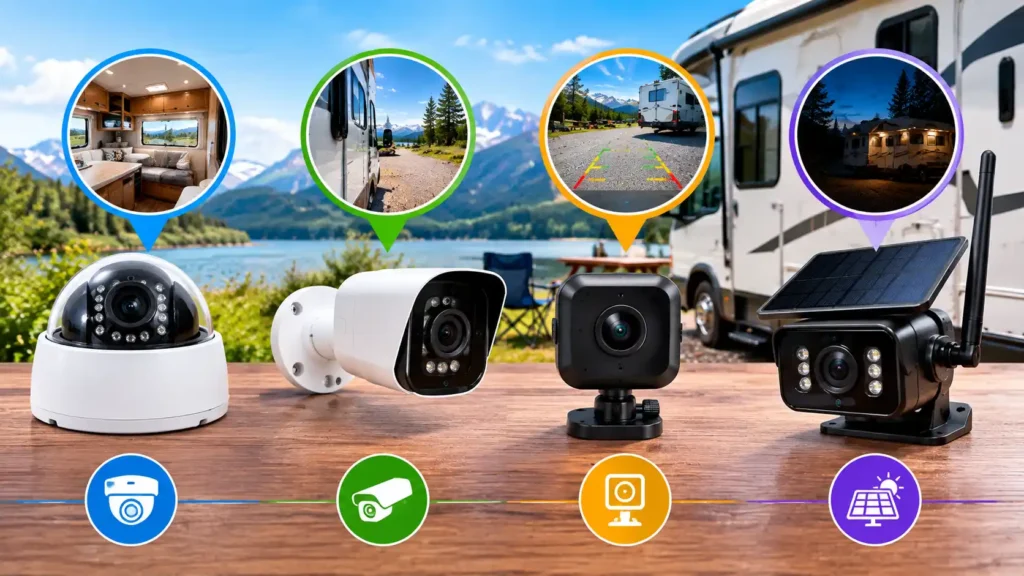
| Camera Type | Power Source | Connectivity | Best For |
| Battery-powered indoor cam | Rechargeable battery | Wi-Fi | Watching the interior while parked |
| Solar outdoor cam | Solar panel plus battery | Wi-Fi or cellular | Long off-grid stretches |
| Plug-in indoor cam | Direct power | Wi-Fi | Full hookup campgrounds |
| Cellular-only cam | Battery or solar | 4G/LTE data | Remote boondocking sites |
Installation Without Damaging Your Rig
Drilling into an RV’s thin aluminum or fiberglass skin can compromise its weatherproofing. Which is exactly why so many mobile friendly cameras rely on VHB tape, magnetic bases or clip on brackets instead of screws.
A clean install usually takes under thirty minutes once you’ve picked your mounting spots. Angling cameras slightly downward toward entry points rather than out toward the horizon, tends to reduce false alerts triggered by passing traffic or wildlife in the distance.
Choosing a Full RV Security Camera System
A single camera covers a lot but a complete rv security camera system pairs cameras with door and window sensors for a fuller picture of what’s happening around your rig. That combination catches both someone approaching the vehicle and someone actually trying to get inside.
For most travelers, two or three cameras covering entry points plus a couple of contact sensors on the main door strikes the right balance between thorough coverage and a setup you can actually manage without a technician.
Recommended Camera Coverage by RV Size
| RV Type | Suggested Camera Count | Priority Coverage Areas |
| Travel trailer / small camper | 1 to 2 | Main door, storage compartment |
| Class C motorhome | 2 to 3 | Entry door, side compartments, rear |
| Class A motorhome | 3 to 4 | Entry door, both sides, rear cargo bay |
| Fifth wheel | 2 to 3 | Main entry, hitch area, storage bays |
Power Management Tips for Longer Trips
Running cameras continuously can quietly eat into your battery bank if you’re not paying attention. A few habits keep that from becoming a problem.
Schedule your system to arm automatically overnight or whenever you leave the site, rather than running at full sensitivity around the clock. Motion triggered recording instead of continuous video also stretches battery life significantly. Since the camera only wakes up and uploads footage when something actually moves.
Common Mistakes RV Owners Make With Security Cameras
Many owners mount a camera once and never revisit the placement. Even after noticing it mostly captures blowing leaves or a neighboring rig. Adjusting the angle after your first few nights out usually fixes this in minutes.
Another frequent misstep is skipping the subscription plan entirely to save money, then discovering there’s no way to retrieve footage after an actual incident. A basic cloud or local storage plan is often the only way to turn a camera from a deterrent into real evidence, especially when you need to recover important camera footage after an incident.
Protecting Your RV While It’s Parked at Home
Plenty of break-ins happen in a driveway, not a campground. Since a parked RV sitting idle for weeks looks like an easy target to anyone chasing the neighborhood. Keeping your camera system armed at home is just as important as arming it on the road.
Setting a nightly automatic arm schedule means you’re covered even during the stretches between trips when you might forget to check the app, while location privacy can help limit unnecessary exposure when you’re travelling. It also gives you a head start on catching any tampering long before your next going off date.
How to Test Your Camera Before a Big Trip
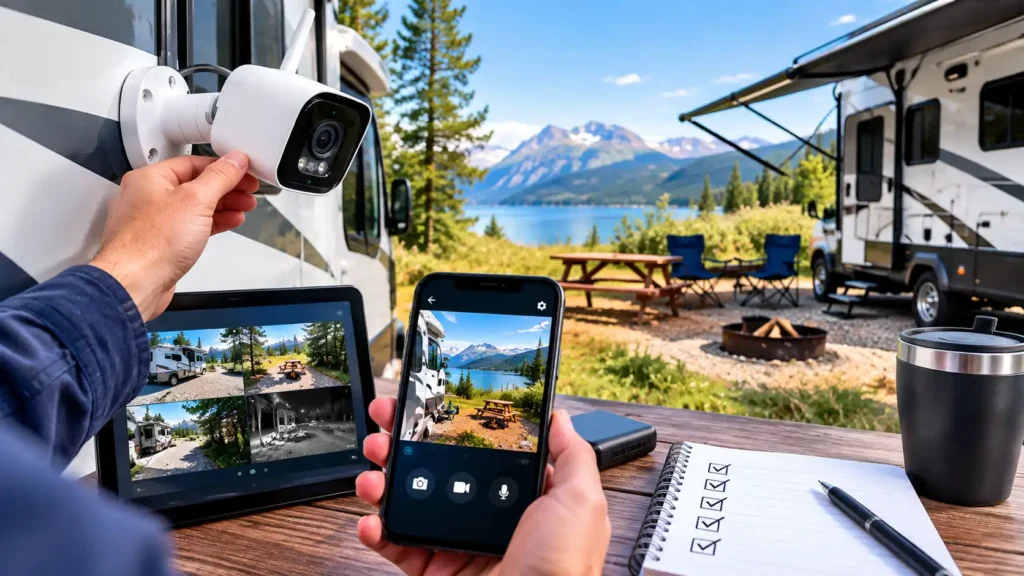
Running a quick test a few days before departure catches dead batteries, weak signal spots and Insecure mounting. While you still have time to fix them. Walk past each camera, trigger the motion sensor and confirm the alert actually reaches your phone.
It’s also merit checking your cellular or WiFi signal strength from the exact spot where the camera will be mounted. Since even a few inches can make a noticeable difference in a metal skinned RV. A short test now saves a frustrating surprise once you’re already parked somewhere remote.
Final Thoughts
Life on the road comes with enough instability without adding security issues to the list. A dependable rv security camera, matched to your power setup and travel style. Turn those worries into background noise instead of a constant distraction, letting you actually enjoy the destinations you worked hard to reach.
FAQs
Can I get an RV security camera no WiFi required?
Yes. Cellular enabled cameras connect through 4G or LTE data instead of a router. So they work at remote trailheads and boondocking sites with zero WiFi signal. Look for a built-in SIM card or data plan rather than a camera that only supports WiFi pairing.
What is a 12 volt RV security camera system and do I need one?
A 12 volt system wires directly into your RV’s existing house battery or electrical panel instead of running on non-reusable batteries or a separate charger. It’s a solid choice if you already have comfortable solar or shore power and want a camera that never needs manual recharging.
What makes the best RV security camera system for most owners?
The best RV security camera system balances no drill installation, flexible power options and dependable connectivity without professional monitoring. Since monitoring centers can’t respond to a vehicle that moves. Matching those three factors to your travel style matters more than trailing any single “top-rated” label.
What should I look for in an RV security camera app?
A strong RV security camera app should send instant push alerts. Let you arm and disarm remotely and stream live video even on a weak cellular connection. Battery status, motion zone customization and simple scheduling are also merit checking before you commit to a system.