
Video games no longer live only on a console in the living room. They sit inside classrooms, factory floors, hiring pipelines and even a child’s after school routine. The rise of technology play gaming has turned something once dismissed as a hobby into one of the most influential forces in modern culture and commerce.
What makes this moment different is convergence. Artificial intelligence, cloud streaming, immersive hardware and a growing awareness of player well being have colliding at the same time. The result has an industry that touches nearly every sector of the economy while still trying to answer a simple question: how do we make play better, safer and more valuable for everyone involved?
Why Gaming Has Outgrown the Living Room
Global gaming revenue has climbed past the combined size of the film and music industries for several years running and the trajectory keeps bending upward. That growth isn’t just about more players buying more titles. It’s about gaming technology bleeding into training rooms, retail showrooms and hospital simulators.
Companies now use game engines to build digital twins of factories. Universities run esports programs that double as career pipelines into broadcast production and network engineering. Retailers use game like loyalty systems to keep customers engaged. The line between “a game” and “a business tool built with game technology” has essentially disappeared.
AI Is Quietly Rebuilding the Development Pipeline
Artificial intelligence has become the backbone of modern game production rather than a novelty feature. Many studios are also adopting AI-powered coding assistants to speed up software development. Our Claude Code vs GitHub Copilot comparison explores how these tools help developers write, review, and maintain code more efficiently. Neural rendering techniques now generate additional frames between traditionally rendered ones and smoothing motion without demanding more raw horsepower from a graphics card. AI assisted graphics models can also fill in visual detail dynamically, cutting down the manual work needed to build dense, realistic environments like forests or city blocks.
These tools matter beyond entertainment. A studio that can render a complex scene faster can also build a training simulation faster which is exactly why enterprise teams are borrowing game development pipelines for onboarding, safety drills and equipment walkthroughs.
Practical tips for teams evaluating AI driven creation tools:
- Test rendering pipelines against your actual asset library not a vendor demo scene.
- Budget for GPU capable workstations even if your team hasn’t building traditional games.
- Treat AI generated assets as a starting draft that still needs human review for accuracy and tone.
Cloud Streaming Removes the Hardware Barrier
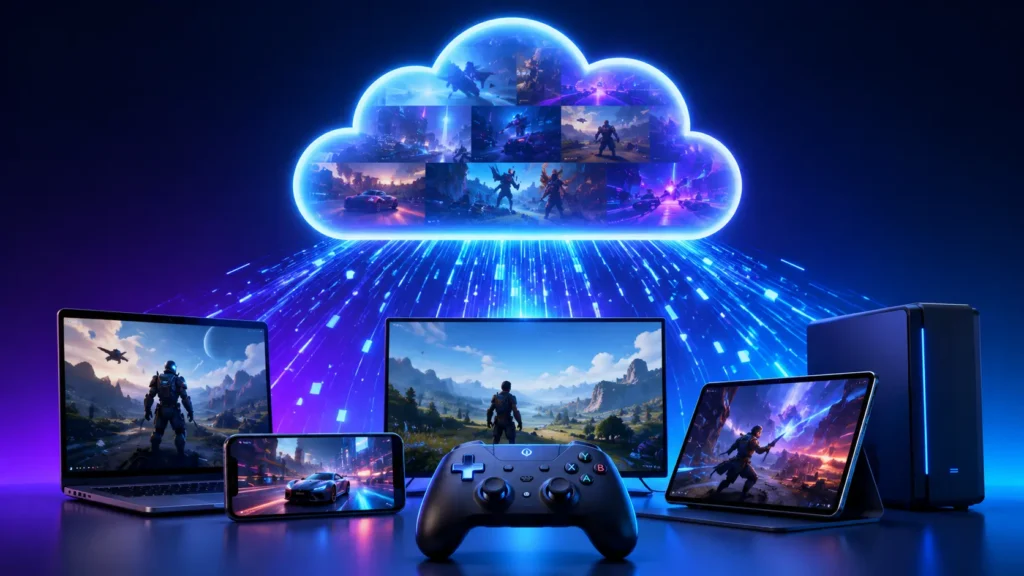
One of the most important shifts in technology play gaming is the move away from requiring expensive local hardware altogether. Cloud gaming platforms now stream demanding experiences from remote data centers to whatever screen a person happens to be holding, whether that’s a laptop, a phone or a browser tab with no dedicated graphics card at all.
This shift matters for reasons that go well past convenience. Organizations building virtual training environments, remote collaboration tools or product demo experiences can deploy them to any employee or customer device without shipping specialized equipment first. A hospital training new staff on emergency procedures or a manufacturer walking a new hire through equipment maintenance, can now do it through a streamed session instead of a dedicated lab.
What Cloud-Delivered Play Enables for Organizations
- Healthcare and safety simulations that scale to hundreds of trainees without new hardware purchases
- Virtual product demonstrations that customers can access from any browser
- Remote collaboration spaces for distributed teams working on shared 3D content
- Interactive learning platforms that adjust difficulty in real time based on performance
Hardware Still Sets the Ceiling on What’s Possible
Software gets the headlines but hardware still determines what a game, simulation or training environment can actually do. Processor and graphics advances keep expanding the size and complexity of the virtual worlds developers can build while new console and PC platforms push further into machine learning optimized workloads.
Serious development work also demands serious workstations. Studios building large open worlds or intricate physics simulations lean on multi core processors and professional grade GPUs that can compile massive codebases. It runs quality assurance virtual machines and render high resolution scenes simultaneously. As remote and hybrid production has become normal that same processing power increasingly needs to travel with the developer rather than staying bolted to a desk in an office. AI-assisted workflows are also changing how development teams manage repetitive tasks. Learn more in Claude Auto Mode Is Changing How Developers Work Smarter, where we explain how automation improves developer productivity.
Virtual and Augmented Reality Move Into the Workplace
Immersive hardware has quietly become one of the most practical tools in industrial and corporate settings. Field technicians use augmented reality overlays to get step by step guidance from a remote expert while both hands stay free for the actual repair. Manufacturers use virtual walkthroughs to train new hires on equipment they can’t safely access during a live production run.
Recruiting has picked up the same tools. Immersive “day in the life” simulations let candidates experience a role before accepting an offer and some employers use game style assessments to evaluate problem solving skills during the hiring process itself. None of this replaces human judgment but it does compress the time it takes to train, evaluate and support a workforce.
Esports Has Become a Legitimate Career Pipeline
Competitive gaming is grow from a niche hobby into an infrastructure investment for schools, cities and companies alike. Universities have building dedicated arenas that teach broadcast production, event management and network engineering alongside competitive play. Corporations use internal tournaments as a team building tool that doubles as a low stakes way to build camaraderie across departments and time zones.
The economic footprint reflects that seriousness. Prize pools, sponsorship deals and full time coaching and analyst roles now exist across dozens of competitive titles and the surrounding technology, from broadcast equipment to low latency networking, has become its own specialized market.
Designing Play With Children’s Well Being at the Center
Nearly nine in ten children play online games at some point which makes responsible design one of the most important conversations in the industry right now. Studios researchers and children’s advocacy organizations are started working together directly rather than treating safety as an afterthought bolted on after launch.
That collaboration has produced shared frameworks that give developers concrete guidance: how to build age appropriate social features how to design reward systems that don’t exploit compulsive behavior and how to give parents meaningful visibility into what their kids have experiencing online. The goal isn’t to strip out fun. It’s to prove that engaging design and a child’s long term well being can be built into the same product from day one rather than treated as competing priorities.
Parents and educators evaluating a new title or platform can look for a few practical signals of responsible design
| What to Check | Why It Matters |
| Clear parental oversight tools | Lets guardians see who a child interacts with |
| Age-appropriate matchmaking | Reduces exposure to inappropriate content or contact |
| Transparent reward systems | Avoids manipulative spending or engagement loops |
| Cloud-based delivery | Adds a layer of monitoring without invasive local software |
Choosing the Right Technology Partner

Whether the goal is building a next title, standing up an internal training simulator or launching a family safe streaming platform, the underlying decision is the same: which processors, engines and hardware partners actually fit the workload. Teams that get this wrong end up rebuilding pipelines mid project. As organizations adopt AI tools, protecting sensitive conversations and project data becomes equally important. Our guide on How to Have Password-Protected Chats in Claude explains practical ways to improve privacy when working with Claude AI. Teams get it right and spend their time on creative and strategic work instead of fighting their tools.
A short checklist before committing to a stack
- Match the game engine to the project’s 2D vs. 3D complexity rather than defaulting to whatever has popular.
- Confirm cloud streaming partners can handle your expected concurrent user load not just a pilot group.
- Plan hardware refresh cycles around GPU driven AI workloads, which age faster than general office hardware.
Final Thoughts
Technology play gaming is stopped being a single industry and become a shared toolkit that touches training, hiring, healthcare, retail and childhood development all at once. Teams evaluating AI assistants for development or research may also want to compare Claude’s subscription options in our Claude Pro vs Max: Plan You Work in 2026 guide before choosing a plan. The organizations getting the most value haven’t necessarily the ones with the biggest budgets. They’ve the ones treating gaming technology science as infrastructure worth planning carefully, rather than a novelty to bolt on later.
FAQs
What is a technology play gaming website?
A technology play gaming website is a platform where users can read gaming news, compare hardware or play browser based games without downloading software. Many also feature cloud streaming options, letting visitors play console quality titles directly through a web browser on any device.
What is a technology play gaming app?
A technology play gaming app has a mobile or desktop application that gives users access to games. It also provides streaming libraries or gaming related tools like performance trackers and parental controls. These apps often sync with cloud services so progress carries over across devices.
How do you set up tech play games on a Samsung Smart TV?
Samsung Smart TVs come with a built in Gaming Hub and have accessible from the home screen. Open Gaming Hub, sign into supported cloud gaming services. Connect a compatible Bluetooth controller and select a game to stream. There no console required.
What is Google Play Games?
Google Play Games has Google platform for accessing Android games on phones, tablets and PCs through a single app. It syncs achievements, saved progress, and purchases across devices and on PC it lets users play mobile first titles with keyboard and mouse support.