
A polished essay comes back with a bright red score attached. Writers, students and editors across the US know that sinking feeling. Every ai detection tool promises a fast, confident answer about who wrote a text, yet the number behind that promise is far messier than it looks.
This guide explains how checkers work, where they fail and how to use them without hurting anyone’s reputation. You will also get practical habits that protect your own work, whether you write, teach, hire or publish.
Why Checkers Matter Now
Text generators have changed classrooms, newsrooms and hiring pipelines in just a few years. Teachers want honest coursework. Editors want writing readers can trust. Recruiters want samples that show real skill.
That pressure built a crowded market of checkers. Many advertise certainty but none can deliver it. How you use the score matters more than the score itself.
How Detectors Spot Patterns
A detector is a classifier trained on large collections of human and machine writing. It uses natural language processing and machine learning to compare your text against the patterns it learned.
Two signals carry the most weight. Perplexity measures how predictable your word choices feel and burstiness measures how much your sentence length and structure vary. The tool then reports a probability so an 80 percent result means “likely” not “proven.”
Are AI Detection Tools Accurate?
Not consistently. Vendors often quote accuracy above 95 percent. But they usually test on clean, unedited samples. Real writing is messier and results shift with text length, topic and editing.
Two errors cause most disputes. A false positive flags human writing as machine made and a false negative lets machine text slip through. Short snippets raise both risks because the model has little context to study.
False Positives Hurt Real Writers
A 2023 Stanford study found that detectors wrongly flagged more than half of the TOEFL essays it tested. Those essays came from nonnative English speakers. Simple vocabulary and predictable grammar look like machine writing to a pattern matching model.
Formal reports, legal drafts and templated business copy face the same trap. One careless accusation can mean a misconduct hearing or a lost freelance client. Always protect the person behind the draft before you trust the percentage.
What Experts Already Concluded
The companies building this technology admit its limits. OpenAI shut down its own text classifier in 2023 because of its low accuracy. That decision tells you how hard the problem is. OpenAI discontinued its AI text classifier in July 2023 because of its low accuracy, highlighting the difficulty of reliably identifying AI-generated writing. Read OpenAI’s explanation of AI text detection limitations for further context.
Some universities reacted too. Vanderbilt turned off Turnitin’s detection feature in 2023 over reliability concerns. Turnitin itself advises schools to treat the score as a starting point for a conversation, not as proof.
Chat GPT Detector Reality Check
People search for a chat gpt detector all the time. But no checker targets one model alone. Most tools look for patterns shared by many generators, including ChatGPT, Claude and Gemini. Readers comparing these platforms can also explore AI tools similar to ChatGPT to understand the wider range of available AI assistants.
That approach has a weak spot. Models update constantly and detectors must retrain to keep up. Mixed drafts cause the biggest headaches. Because a human outline plus a machine polished paragraph lands in a gray middle zone.
Turnitin AI Detector for Schools
The AI detector that Turnitin is marketing is buried in the learning platforms that many US schools use already. Teachers see a percentage and highlighted passages in addition to the traditional similarity report.
Students can’t typically run this themselves, which creates an unfair process. Students exploring other AI services can also read about the Google Gemini AI student offer and check the latest eligibility and offer details. Teachers should ask for drafts and/or notes and conduct an oral walkthrough (as needed) prior to making a decision about a student’s grade. A fair process has these check and balances.
GPTZero Under the Microscope
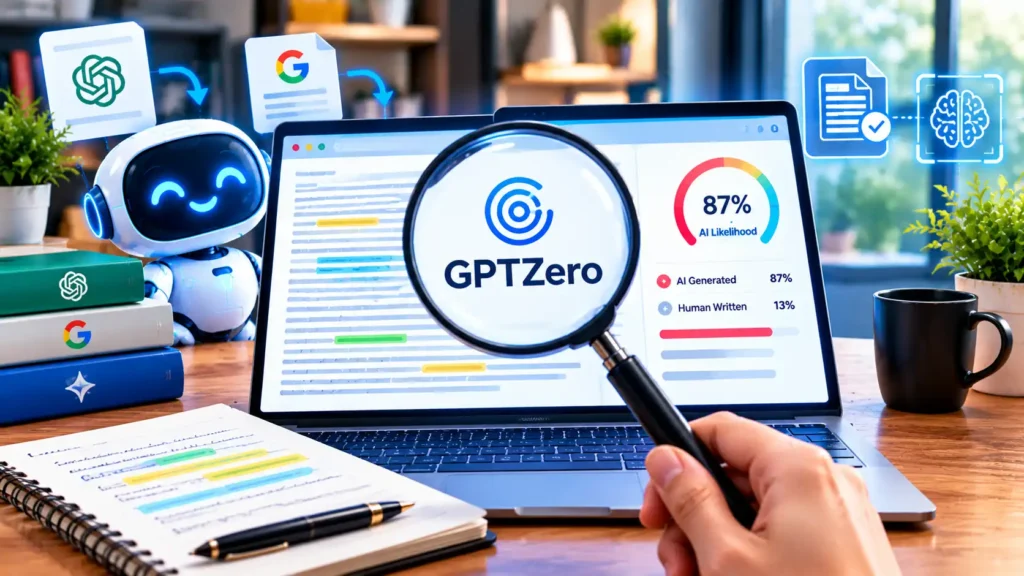
The GPTZero AI detection tool earned its reputation in education and remains one of the most recognized names. It labels text as human, mixed or machine written and highlights the sentences that raised suspicion.
Its explanations stand out, because premium reports show which phrases pushed the score. Still it hedges on polished or lightly edited writing. Use it as one voice in a small panel of checkers not as the judge.
Free Options That Work
“A quick sanity check” is easy with a free AI content detection tool. Pasting text without paying is allowed with Sapling, ZeroGPT and GPTZero but they limit how much you can scan.
With free plans, expect ads and limits to scan lengths. Also expect less reliable results on shorter samples. Publish your work at your own risk. When you pay, you get better results, file uploads, plagiarism checks and shareable reports. Schools and publishers often require these.
Popular Checkers Compared
Each platform fits a slightly different user. Match the tool to your goal instead of chasing the boldest promise.
| Tool | Best For | Free Access | Watch Out For |
| Sapling | Quick spot checks | Limited characters per scan | Free cap suits short samples |
| Pangram | Students and educators | Small daily credit allowance | Needs a decent word count |
| GPTZero | Sentence level explanations | Monthly word allowance | Often hedges on edited text |
| Copyleaks | Large documents, plagiarism checks | A few free scans | Slower on big files |
| Winston AI | Image, handwriting, PDF scans | Short trial period | Tight trial limits |
| Originality.ai | Publishers and content teams | Paid credits only | Strict settings may over-flag |
| Turnitin | Schools and universities | Institution access only | Students rarely see results first |
Features and limits change often. Confirm current details on each vendor’s website before you commit.
Where Businesses Use Detectors
Businesses now screen far more than essays. Marketing teams review outsourced blog posts, HR teams read cover letters and online stores filter suspicious reviews. Teams looking to improve their daily workflows can also explore the best AI productivity tools for writing, research and content management.
The goal differs in each case so the risk differs too.
| Use Case | What to Check | Main Risk |
| Freelance deliverables | Voice, sourcing, originality | Rejecting strong writers by mistake |
| Hiring samples | Specific stories, real examples | Penalizing polished candidates |
| Product reviews | Repeated phrasing across accounts | Deleting genuine feedback |
| Academic work | Drafts, notes, citations | Accusing honest students |
Every row teaches the same lesson. A score opens an investigation and human review closes it.
My Experience with AI Detection Tools
When comparing AI detection tools, I found that ZeroGPT, Pangram, Originality.ai and Turnitin serve similar purposes but may produce different results. A paragraph that appears human written to one detector may receive a different score from another. This highlights why I would not rely on a single tool to judge writing authenticity. Each platform has its own detection methods, features and access limits. For a fair comparison, I recommend testing the same human written and AI-generated samples across all four tools.
In my experience, ZeroGPT is the easiest AI detection tool to use. Its straightforward interface helps me check content without spending too much time understanding complicated features. I feel more confident when reviewing its results and its simple approach gives me greater peace of mind during my writing process. Compared with ZeroGPT, I find tools such as Pangram, Originality.ai and Turnitin more challenging to understand. Particularly when I am unfamiliar with their features. However, ease of use and personal confidence do not guarantee perfect accuracy. I recommend comparing results with other detectors and reviewing the content manually before making a final judgement.
Smart Checklist Before You Trust a Score
Run through this list every time a report lands on your desk.
- Scan at least 300 words because short snippets produce shaky results
- Compare two or three checkers instead of trusting one
- Treat middle range scores as inconclusive, not as evidence
- Read the highlighted sentences yourself, not only the headline number
- Check version history and drafts as supporting proof
- Expect false alarms on formal, technical and nonnative writing
- Never base a penalty, firing or rejection just a score alone
Follow these steps and you will avoids most unfair accusations. They also make your review process easy to defend.
Protect Your Own Writing
You can’t control a checker but you can control your evidence. Use Google Docs or Word and turn on ‘Version history’ to draft and save notes, outlines and links to research and source material. You can also explore how AI that types stuff for you in Docs works when using AI-assisted writing features.
Next use your natural voice and include details that only you would know. Include a local example or lesson learned the hard way. Mix up the length of your sentences and read the draft aloud to find and fix stiff unnatural language.
What to Do If You Get Flagged
Stay calm and ask for the full report first. A headline number tells you little. While the highlighted passages show what triggered the alert.
Then share your drafts, notes and version history and offer to explain your argument out loud. Point to published research on false positives and request a human review. Polite, documented replies settle most disputes quickly.
Google and Machine Written Text
Site owners often ask whether detector scores affect search rankings. They do not. Google has said it rewards helpful, people first content no matter how someone produces it.
What Google targets is spam and meaning mass produced pages built to manipulate rankings. Focus on accuracy, firsthand experience and clear sourcing. Those qualities match Google’s EEAT principles and serve readers far better than any score.
Final Thoughts
Detection technology will continue to improve. But it will never replace human judgment. A single AI detection tool provides a hint, not a final conclusion.
Smart users compare results from multiple detectors, carefully examine flagged passages manually and maintain reliable drafting records. Consider every score the beginning of a discussion, not the final decision. This careful approach protects honest writers and the readers who rely on them.
FAQs
What is the best free checker for a quick scan?
Each of Sapling, ZeroGPT, and GPTZero has a free plan with a quick signup (if any) and a limited number of characters per paste. Take advantage of each to get multiple quick scans. Because you can’t totally trust the results, you’ll want to confirm them using a second checker before taking any action.
Is the Turnitin AI detector reliable?
It gives schools a useful signal but it can still produce false positives and misses. Turnitin itself says instructors should use the score as a starting point for a conversation, not as proof of misconduct. Drafts, notes and the student’s own explanation give a far fairer picture than a percentage.
Can a chat gpt detector catch edited text?
It varies but generally scores low. Heavy rewriting leads to a loss of patterns, especially if the rewrite contains varied sentences and personal examples. Slightly altered rewrites can be used to support a claim. Results in an uncertain middle zone should be treated as inconclusive. Look for other evidence to support your position.
Does Google penalize machine written content?
No. Google says it rewards helpful, people first content however someone creates it. It targets spam such as mass produced pages built to manipulate rankings. Focus on accuracy, firsthand experience and real usefulness instead of chasing a detector score. Because detector scores play no role in search rankings.